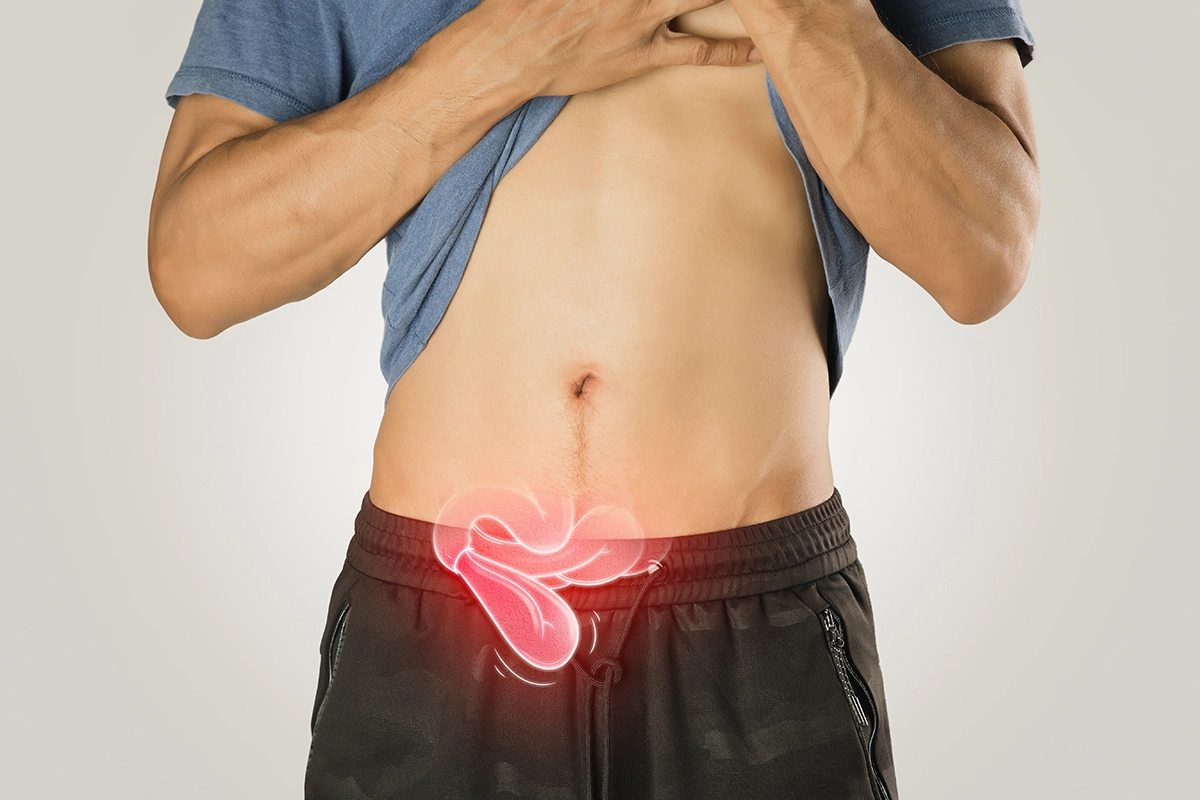

An inguinal hernia is a groin bulge caused by tissue pushing through a weakness in the abdominal wall. Choosing treatment involves understanding your symptoms, the available operations and the trade-offs that matter to you.
This article draws on the patient decision aid Making a decision about inguinal hernia, produced by the Winton Centre for Risk and Evidence Communication and NHS England, last updated September 2023, supplemented here by NHS information and international hernia guidelines. This is an independent explanation of established advice.
How Does an Inguinal Hernia Affect Your Daily Life?
The impact of an inguinal hernia extends beyond the size of the bulge or the discomfort it causes. Some people experience mild symptoms but remain concerned about physical activity or potential complications. Others find that their hernia affects their daily routines.
When discussing treatment with your surgeon, consider how the condition affects different aspects of your life:
- Work and physical activities: Does lifting, bending or standing for long periods cause discomfort?
- Daily routines: Have you stopped or modified certain activities because of the hernia?
- Intimacy and personal well-being: Does the hernia affect your comfort, confidence or relationships?
- Concerns about the future: Are you worried about the hernia enlarging, becoming painful or requiring emergency treatment?
Being specific about these concerns can help your surgeon understand your limitations and treatment goals. However, groin pain can also arise from conditions other than an inguinal hernia. Even when a hernia is present, surgery may not resolve every symptom if another condition contributes to the discomfort.
Can You Delay Inguinal Hernia Surgery?
Watchful waiting may be suitable for some men with asymptomatic or minimally symptomatic inguinal hernias. This involves monitoring the condition rather than undergoing immediate surgery, with reassessment if symptoms develop or worsen.
Watchful waiting may be considered when:
- The hernia causes little or no discomfort.
- Daily activities are not significantly affected.
- There are no signs of complications requiring urgent treatment.
- The patient understands when to seek reassessment.
For appropriately selected men, the risk of an acute hernia emergency during watchful waiting is generally low, although it is not zero. Some patients eventually undergo surgery as symptoms become more troublesome.
Note for Women: International guidelines generally recommend timely repair for nonpregnant women with groin hernias because femoral hernias are more common in women and carry a greater risk of emergency complications.
The decision to monitor or operate should therefore follow an individual assessment rather than symptoms alone.
What Should You Know About Inguinal Hernia Surgery?
If surgery is recommended, understanding the proposed procedure can help you weigh its benefits and limitations.
The two main approaches are:
- Open repair: The surgeon makes an incision in the groin to return the protruding tissue to its normal position and repair the weakened area.
- Laparoscopic (keyhole) repair: The surgeon uses several small incisions, a camera and specialised instruments to repair the hernia from within the abdominal wall.
Robotic assistance may also be used for selected minimally invasive repairs, depending on clinical suitability and availability.
Both open and minimally invasive techniques aim to repair the hernia and reduce recurrence risk, but they differ in their surgical methods, anaesthesia requirements and recovery considerations.
The recommended technique depends on factors such as the hernia's characteristics, previous operations, overall health and the surgeon's experience.
Rather than focusing solely on which procedure is newer or less invasive, ask why a particular approach is suitable for your condition and what alternatives are available.
Is Mesh Always Necessary for Inguinal Hernia Repair?
No. Although surgical mesh is recommended for most inguinal hernia repairs, non-mesh techniques may be considered for carefully selected patients.
Mesh reinforces the weakened abdominal wall and reduces the likelihood of recurrence. International guidelines generally favour mesh-based repair because it is associated with lower recurrence rates without an overall increase in chronic pain compared with non-mesh techniques.
However, some patients may be suitable for repair using stitches alone. When non-mesh repair is selected, international guidelines recommend the Shouldice technique, provided the surgeon has appropriate experience.
Patients should discuss why mesh or non-mesh repair is recommended, whether suitable alternatives are available and how the approaches compare in terms of recurrence risk and persistent pain.
The aim is to identify an approach that offers an appropriate balance of benefits and risks for the individual.

What Should You Expect During Recovery From Hernia Surgery?
Many patients return home on the day of inguinal hernia repair. Bruising, swelling and temporary discomfort are common, with overall recovery typically taking 4–6 weeks. Light activities, such as walking, can often resume earlier, while returning to strenuous activities depends on individual recovery and the surgeon's advice.
Before surgery, consider making arrangements for:
- Transport: Having someone accompany you home after the procedure.
- Work and household responsibilities: Planning time off or assistance with physically demanding tasks.
- Returning to activities: Clarifying when you can resume driving, exercise and heavy lifting.
- Follow-up care: Knowing whom to contact if recovery does not progress as expected.
Potential complications include infection, difficulty passing urine, persistent groin pain and hernia recurrence. Discussing these risks beforehand can help you make an informed treatment decision.
When Does an Inguinal Hernia Require Emergency Treatment?
An inguinal hernia may become a medical emergency if protruding tissue becomes trapped and cannot return to the abdomen, particularly if its blood supply is compromised.
Seek immediate medical attention if you experience:
- Sudden, severe or rapidly worsening groin pain.
- A hernia bulge that becomes hard, tender or cannot be pushed back as usual.
- Vomiting or significant abdominal swelling.
- Redness or discolouration over the hernia.
- Difficulty passing stools or wind, particularly alongside abdominal pain or vomiting.
These symptoms may indicate an incarcerated hernia, bowel obstruction or strangulation, where trapped tissue loses its blood supply.
A suspected strangulated hernia requires emergency assessment and may require urgent surgery. Do not attempt to force a painful, irreducible hernia back into place or wait for a routine appointment.
What Questions Should You Ask Your Surgeon About Hernia Treatment?
After considering how an inguinal hernia affects your daily life, the available management options and the potential risks of surgery, the next step is to discuss these factors with your surgeon.
The following questions can help you clarify your options and make a decision based on your individual circumstances.
- Which symptoms is treatment likely to improve?
- Is observation appropriate for my particular hernia?
- Why do you recommend this operation and anaesthetic?
- What are my individual risks of recurrence and lasting pain?
- What should I expect during recovery, and whom do I contact with concerns?
You may also wish to request a written treatment or monitoring plan outlining the next steps, follow-up arrangements and contact details for any concerns.
Make Informed Hernia Treatment Decisions With Dr Sujit Singh Gill
Choosing how to manage an inguinal hernia involves more than deciding whether to undergo surgery. It requires considering how the condition affects your daily life, understanding the available treatment options and weighing their potential benefits and risks.
At The Vascular & General Surgery Centre, Dr Sujit Singh Gill assesses inguinal hernias with consideration for each patient's symptoms, overall health and individual circumstances. Through discussion of the available management options, patients can better understand whether continued monitoring or surgical repair may be appropriate for their condition.
If you have been diagnosed with an inguinal hernia or would like to discuss your treatment options, schedule a consultation with Dr Sujit Singh Gill for an individual assessment.
FAQs About Inguinal Hernia Treatment
Can an inguinal hernia heal without surgery?
An inguinal hernia generally cannot heal on its own because the underlying weakness in the abdominal wall remains. Although some patients may be able to monitor their condition without immediate treatment, surgery is the only way to repair the hernia. However, not every inguinal hernia requires immediate surgical intervention.
Will an inguinal hernia get worse if left untreated?
An inguinal hernia may gradually enlarge or become more symptomatic over time, although the rate of progression varies. Some people experience minimal changes for extended periods, while others develop increasing discomfort or functional limitations. Regular reassessment can help determine whether continued monitoring remains appropriate.
Can you exercise if you have an inguinal hernia?
Some people with minimally symptomatic inguinal hernias can continue exercising, although activities that increase abdominal pressure may aggravate discomfort. The suitability of different exercises depends on the hernia's characteristics and symptoms. Patients should seek medical advice about appropriate activity levels, particularly if exercise causes pain or increases the bulge.
Can an inguinal hernia return after surgery?
Yes. Although surgical repair aims to correct the hernia and strengthen the affected area, recurrence remains possible. Factors such as the repair technique, hernia characteristics and individual health may influence this risk. Your surgeon can explain the likelihood of recurrence based on your circumstances.
References
- Winton Centre for Risk and Evidence Communication and NHS England. Making a decision about inguinal hernia. Patient decision aid. Updated September 2023. Original booklet, particularly pages 3, 5 and 10.
- National Institute of Diabetes and Digestive and Kidney Diseases. Inguinal Hernia. Reviewed September 2019. Patient information.
- The HerniaSurge Group. International guidelines for groin hernia management. Hernia. 2018;22:1–165. doi:10.1007/s10029-017-1668-x.
- NHS. Inguinal hernia repair. Reviewed 28 February 2025. Patient information.
- Stabilini C, et al. Update of the international HerniaSurge guidelines for groin hernia management. BJS Open. 2023;7(5). doi:10.1093/bjsopen/zrad080.